
Bertrand Russell: Reason, Courage, and the Quiet Power of Non-Violence

By Barbara Wilde
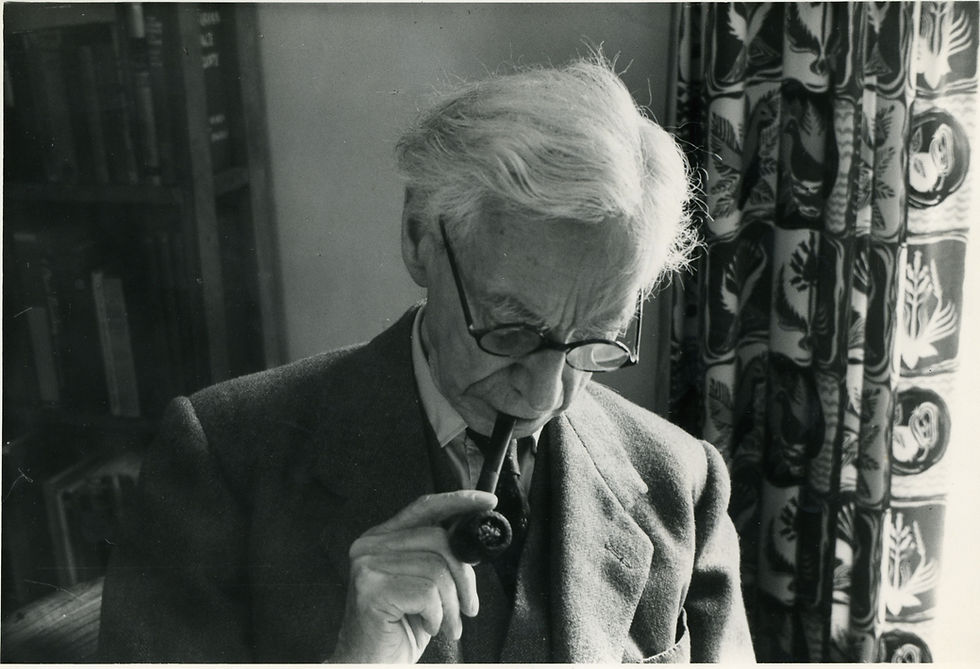
In my opinion, certain people in history do not simply belong to their time; they seem, somehow, to speak across generations, as if what they have understood about life remains relevant regardless of context, culture, or era. Bertrand Russell is, for me, one of those voices.
Perhaps it is also because I live in England now, as an Italian woman who has chosen to build her life here, that I feel a certain closeness to figures like him. There is something in the British intellectual tradition that fascinates me—this ability to hold together reason, restraint, and, at the same time, a very deep moral positioning, which Russell embodies beautifully.
We often remember him as a mathematician, as one of the greatest minds behind Principia Mathematica, written with Alfred North Whitehead and of course, that alone would have been enough to secure his place in history; even now, Russell’s voice reached far beyond mathematics. In 1950, he was awarded the Nobel Prize in Literature, a recognition that, to me, speaks of something deeper: a man who used his words not only to think, but to elevate human consciousness and defend freedom of thought.
A man who did not hide behind his intelligence
What I deeply respect in Russell is that he never used his intellect as a shield. He did not remain in abstraction. He allowed his thinking to touch life, and, more importantly, he allowed it to guide his actions. In his contemporary world that was moving towards war twice, he did not stay silent.
During the First World War, he openly opposed conscription. He spoke against violence when it was far easier, and certainly more convenient, to conform, and he paid the price for it. He lost his position at Cambridge, and eventually, he was imprisoned.
Why does that make me think of and admire him? Because it is one thing to have ideas, but it is another thing entirely to stand by them when there are real and serious consequences, and Russell did it.
A sentence that becomes a way of living
There is a quote by Bertrand Russell that, the first time I encountered it, did not strike me loudly, but rather settled somewhere inside me, quietly, and then stayed.
“To fear love is to fear life, and those who fear life are already three parts dead.”
Russell wrote extensively about human happiness, freedom, and the conditions that allow a life to feel meaningful rather than merely endured. This sentence, in particular, emerges from his broader reflection on emotional openness as an essential dimension of a fulfilled existence. His vision was far from love as a romantic idealisation; it was as a fundamental expression of being alive, an orientation, towards connection, towards participation, towards presence.
Therefore, the more I have reflected on it, the more I have recognised how radical it actually is.
Because what Russell is pointing to isn’t limited to the fear in the abstract, but a very specific kind of fear: the fear of exposure. The fear of being seen. The fear of entering into relationships, experiences, and choices without guarantees.
And this is where it becomes deeply relevant for me, not only intellectually, but personally, and professionally, as a coach.
Over the years, through my work and also through my own life, I have come to understand that fear is rarely loud or dramatic. Much more often, it appears as control, as self-containment, as a careful and almost elegant holding back. People function, they succeed, they build, they perform, and yet, somewhere within, they remain slightly withdrawn from life.
This is due not to a lack of desire, but instead, because they sense, often very accurately, that to live fully would require something of them, such as openness, vulnerability, the possibility of being touched, and therefore also of being hurt; so they are in survival mode, they are understandably protecting themselves.
But this is precisely the point Russell makes, and the point that, over time, has become almost a guiding principle in my own way of living and coaching: when we avoid experiencing life and therefore love to protect ourselves (consciously or unconsciously), we are not preserving life, we are diminishing its intensity by remaining present, but not fully engaged, therefore, we experience, but without fully entering the experience. Consequently and gradually, almost imperceptibly, by reducing the depth of what we can feel.
As a coach, I can see this pattern with extraordinary clarity. Intelligent, capable, sensitive individuals who are, in many ways, already equipped to live deeply fulfilling lives, yet they hold back at precisely the point where life begins to ask for something more honest, more exposed, more real.
This is why Russell’s words feel, to me, so profoundly aligned with my vision and coaching. What is meant to me, coaching, at its core, is not about fixing, nor about optimising performance in a superficial way. It is over all about supporting a person in stepping more fully and deeply into their own life, which always involves risk and also always involves feeling.
So this sentence, over time, has become more and more something I practise. A reminder that aliveness is not found in control, but in participation. That safety, when pursued at all costs, can quietly become a limitation, and that choosing to love and to engage, to trust, to open means, ultimately, choosing to live.

Non-violence as a form of strength
What moves me deeply, when I think about Russell, is the quality of presence within his philosophy. His commitment to non-violence expresses a clear, grounded, and intentional position, rooted in awareness rather than reaction.
In the later years of his life, during the Cold War, he stepped forward as one of the most influential voices against nuclear weapons. Alongside Albert Einstein, he signed the Russell–Einstein Manifesto, inviting humanity towards disarmament and towards a more conscious, responsible use of scientific knowledge.
There is a quiet strength in all of this that I find profoundly meaningful: a man devoted to logic, mathematics, and reason, who repeatedly chooses to stand for life; a presence that expresses itself with clarity, with dignity, and with continuity; a form of courage that does not seek to dominate the space, yet naturally transforms it.
What I take from him today
As a coach, and also simply as a woman who observes people, relationships, and dynamics, I find Russell’s perspective very grounding.
We live in a time where everything moves fast, where reactions are immediate, and where fear often drives decisions without even being recognised as such. Thus far, his message feels almost like an invitation to slow down and ask a different question: Am I living fully, or am I protecting myself from life? Because there is a substantial difference between them, and it can be a very subtle one.
Coaching Insight
Fear does not always look dramatic. Very often, it looks like hesitation. Like control. Like keeping things “under control” and still, underneath, there is often a simple truth: we are trying to avoid feeling too much.
Russell reminds us, in a very direct way, that avoiding feeling is not the same as living. Therefore, the powerful question becomes:
Where, in my life, am I choosing protection instead of participation?
Because every time we choose to step in, to speak, to feel, to connect, we are, quite literally, choosing life; and perhaps, that is the most radical and human choice we can make.


Comments